
 EN
EN
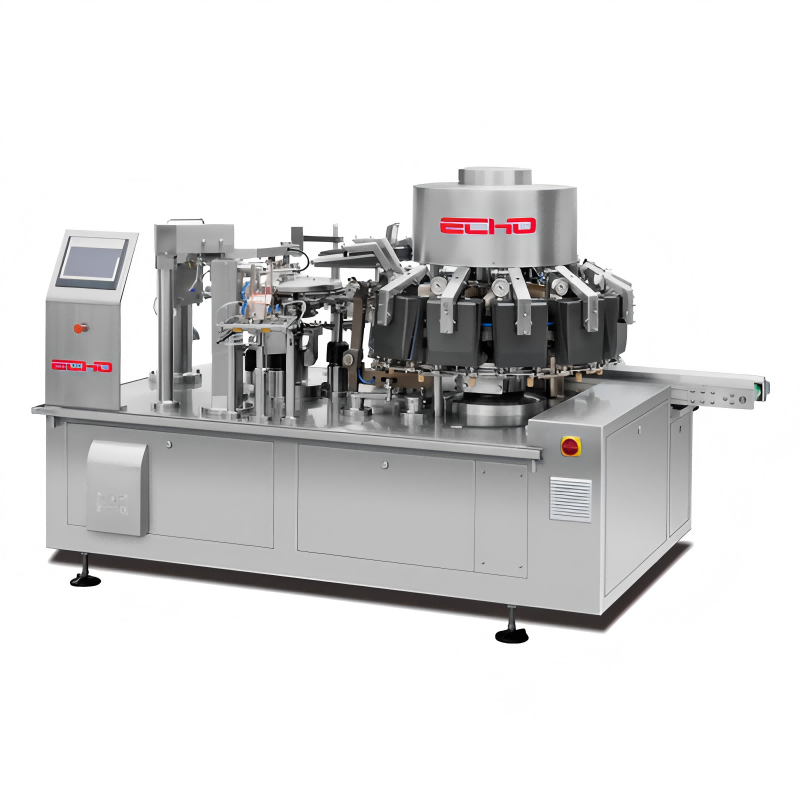
How a Vertical Flow Wrapper Handles Loose and Bulk Products
Loose products — granola clusters, frozen berries, hardware fasteners, detergent powder — share one packaging challenge: they do not arrive at the filling station in neat, countable units. They flow, clump, and generate dust. A vertical flow wrapper — a vertical form-fill-seal (VFFS) machine — is designed from the ground up to handle this unpredictability with speed, accuracy, and seal reliability that horizontal alternatives cannot match.
The VFFS Cycle — Form, Fill, Seal, Separate
A vertical flow wrapper forms packaging from roll-stock film in a continuous vertical cycle. Film unwinds from a roll, passes over a forming collar that shapes it into a tube around a vertical filling mandrel, and receives a longitudinal heat seal. Product drops through the mandrel from above. Below the fill zone, rotating sealing jaws close horizontally, creating the top seal of one bag and bottom seal of the next simultaneously. A knife separates the sealed bag, and the cycle repeats — typically 30 to 120 bags per minute. Gravity moves product into the package. There is no horizontal conveyor to spill from, no pocket to misalign, no mechanical transfer to crush fragile items. Multi-head weighers mounted above dispense precise target weights with accuracy within ±1 gram for small portions.
Real-World Case — A Granola Manufacturer's Switch from Pre-Made Bags
A UK granola manufacturer used pre-made stand-up pouches on a semi-automatic line — four operators, two stations, output capped at 18 bags per minute. Pre-made bags cost £0.08 each. Installing a vertical flow wrapper with an integrated 10-head weigher cut film cost to £0.03 per bag and raised output to 55 bags per minute with two operators. Size changeover fell from 45 minutes to under 10 minutes via digital recipe storage. Annual material savings exceeded £60,000, recovering the machine cost within 18 months.
Technical Demands of Loose and Bulk Goods
Weighing Accuracy, Dust Management, and Seal Integrity
Loose products demand three things from a vertical flow wrapper. First, multi-head weighers use 10 to 14 weigh buckets, each holding a fraction of target weight. The controller selects the bucket combination closest to target — a statistical approach that compensates for individual variance and achieves higher accuracy than single-scale filling.
Second, powdered products generate airborne dust during filling that contaminates seal surfaces. A seal jaw with dust on it cannot create a hermetic closure. Dust extraction at the fill tube and Teflon-coated seal jaws resist dust adhesion, while positive air purge cleans the seal zone before jaw closure.
Third, product in the seal zone produces leakers — packages that fail under handling. Film stripping mechanisms shake residual product off the film above the seal zone before jaws close, a feature that directly determines leaker rates on powder lines.
Film Selection and Machine Configuration
Matching Film to Product and Application
Film choice is application-specific. Snack foods use multi-layer OPP/PE or PET/PE laminates balancing moisture barrier, puncture resistance, and seal strength. Powders need anti-static surface treatment preventing dust adhesion on package exteriors. Frozen products require films rated for cold-temperature seal integrity. The film structure must match the seal jaw type — rotary jaws for high-speed thin films, box-motion jaws for thicker laminates and gusseted bags requiring longer dwell time.
Choosing the Right Machine
Five Key Evaluation Points
First, determine product density and target fill weight — these size the forming tube diameter and weigher head count. Second, assess dust generation; if the product is powder, dust extraction and seal-zone air purge are mandatory. Third, specify required bag styles — pillow, gusseted, quad-seal — and confirm tooling availability. Fourth, verify seal jaw type: rotary for speed, box-motion for thick laminates. Fifth, audit film waste during startup and changeover; automatic registration and recipe storage minimize transition waste. A vertical flow wrapper configured for the specific bulk product pays for itself through material savings, labor reduction, and lower leaker rates.
Frequently Asked Questions
What is a vertical flow wrapper and how does it work?
A vertical flow wrapper — a VFFS machine — forms roll-stock film into a vertical tube around a filling mandrel, drops product through from above, and creates horizontal seals above and below each package. Gravity feeds the product, making it ideal for loose, granular, and powdered goods.
What products are best suited for a vertical flow wrapper?
Loose and bulk products — snack foods, granola, nuts, frozen vegetables, pet food, hardware fasteners, detergent, protein powder, spices, and coffee — are ideal for a vertical flow wrapper. Any product flowing under gravity and benefiting from high-speed weight-based filling is a strong candidate.
How does a multi-head weigher improve accuracy?
A multi-head weigher uses 10 to 14 buckets, each holding a fraction of target weight. The controller selects the combination summing closest to target, achieving ±1 gram accuracy for small portions. This statistical method outperforms single-scale filling for loose, non-uniform products.
What film types are used for food packaging?
Multi-layer OPP/PE or PET/PE laminates provide moisture barrier, puncture resistance, and seal strength for snack foods. Powders need anti-static films. Frozen products require cold-temperature-rated films maintaining seal integrity against sharp frozen edges.
Why is dust management critical in vertical flow wrapper operation?
Powdered products generate dust that settles on seal jaw surfaces. Dust-contaminated seals create leakers — packages that fail despite appearing sealed. Dust extraction, Teflon-coated jaws, and positive air purge cleaning the seal zone before closure are essential for powder applications.
How fast can a vertical flow wrapper package bulk goods?
A vertical flow wrapper typically packages 30 to 120 bags per minute depending on bag size and product flow. Smaller bags run at the higher end; larger bulk fills (1 kg to 5 kg) run slower due to fill time but still significantly outpace manual alternatives.