
 EN
EN
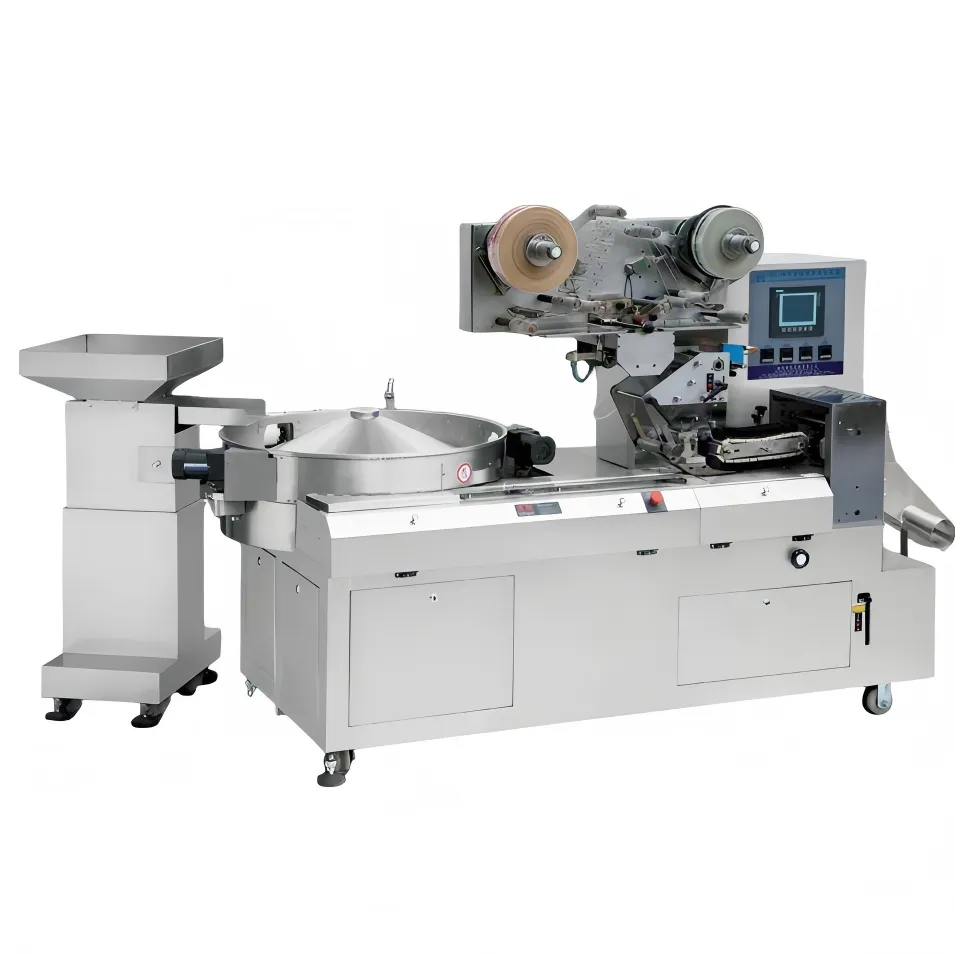
The Horizontal Advantage: Why Long and Solid Products Flow Better Through an HFFS Machine
A candy bar measuring 15 centimeters, a hardware bolt packed in pairs, a cylindrical biscuit roll — each of these products shares a geometry that frustrates vertical packaging systems. In a vertical form-fill-seal machine, the product drops through a forming tube under gravity, lands on the bottom seal of the bag, and waits for the top seal to close. Long products tumble during the drop, landing at unpredictable angles that create misaligned seals and crushed edges. Solid products with irregular shapes catch on the forming tube walls, jamming the filling cycle.
A horizontal packaging machine — also called a horizontal form-fill-seal (HFFS) machine or flow wrapper — solves this geometry problem by keeping the product oriented and controlled throughout the packaging cycle. The product travels horizontally on a conveyor, is wrapped by film that forms around it rather than dropped into a pre-formed bag, and is sealed at both ends while moving continuously through the machine — eliminating the gravity drop, the orientation uncertainty, and the jamming risk that make vertical machines unsuitable for long and solid products.
How the HFFS Process Handles Product Geometry
Horizontal Transport: Controlled Orientation
In an HFFS machine, products enter on an infeed conveyor in a single-file orientation — candy bars aligned lengthwise, hardware components spaced at consistent intervals, baked goods placed flat — and maintain that orientation throughout the packaging cycle. The film forms a tube around the product as both move forward together, wrapping the product rather than requiring the product to enter a pre-formed cavity. This continuous-motion wrapping is what allows HFFS machines to handle products that would tumble uncontrollably in a vertical drop.
ECHO Machinery's DXD-1200/1600 series horizontal form-fill-seal machine demonstrates this principle at production speeds of up to 1,200–1,600 bags per minute — throughput that vertical machines cannot match for long or irregular solid products because the gravity-drop cycle time limits their speed regardless of motor power. The servo-driven film feeding and synchronized horizontal sealing in ECHO's HFFS design maintain consistent bag length, seal quality, and film registration at these high speeds — the key variables that determine whether a high-speed machine produces saleable packages or high-speed waste.
Synchronized Sealing: Quality at Speed
The horizontal sealing mechanism in an HFFS machine must seal the film tube's longitudinal seam (the fin seal running along the package length) and the cross-seals between individual packages — all while the film and product are moving continuously. The synchronization between film speed and sealing jaw speed determines whether the seals are straight (film and jaws moving at the same speed) or wrinkled (speed mismatch creating film bunching at the seal point). ECHO's DXD series achieves this synchronization through servo-driven control that electronically coordinates film feed rate with jaw movement, eliminating the mechanical linkages that drift out of adjustment in cam-driven systems and produce the seal-quality degradation that operators compensate for by reducing machine speed.
Real-World Application: Biscuit Line Switch from Vertical to Horizontal
A biscuit manufacturer in Southeast Asia had been running a vertical form-fill-seal line for individually wrapped cream-filled wafer rolls — cylindrical products measuring 12 cm in length. The vertical machine's gravity-drop filling caused approximately 8% of wafers to land at an angle in the bag, creating diagonal seals that leaked air and left 2–3 mm of exposed product at the seal line. Rejected packages from seal-quality inspection averaged 6% of output, and operator intervention to clear jams stopped the line for 15–20 minutes per shift.
Switching to a horizontal packaging machine — specifically ECHO Machinery's DXD series configured for the product's 12 cm length — eliminated the orientation problem entirely. Products now arrive on the infeed conveyor pre-aligned, maintain their position through the film-wrapping zone, and exit with seal margins of 5 mm on both ends — consistent, perpendicular, and leak-free. Reject rates dropped from 6% to under 0.5%, and jam-related downtime disappeared because products no longer contact the forming tube walls during packaging. The line speed increased from 80 to 140 packs per minute — not because the motor runs faster, but because the continuous wrapping cycle eliminates the stop-and-wait that vertical machines require between fills. The biscuit producer recovered the equipment investment in 14 months from reduced product waste and increased throughput alone.
Frequently Asked Questions
What types of products suit a horizontal packaging machine?
Long, solid, and piece-shaped products — candy bars, granola bars, biscuits, hardware items, medical devices in pouches, cylindrical snacks, and bakery products — all benefit from the horizontal orientation that prevents tumbling and misalignment. ECHO Machinery's DXD series is specifically designed for small-sized granular and piece-shaped items in the confectionery, snack, and pharmaceutical industries.
What is the speed range of a modern HFFS machine?
Entry-level HFFS machines operate at 100–300 bags per minute. High-performance servo-driven machines like ECHO's DXD-1200/1600 achieve up to 1,200–1,600 bags per minute for small-format packages. Speed depends on product dimensions, film type, and seal dwell time requirements — longer packages or thicker films require proportionally slower speeds.
How does film changeover work on an HFFS machine?
Film rolls are loaded onto a spindle at the rear of the machine, threaded through the forming shoulder and sealing jaws according to a threading diagram printed on the machine. Quick-change designs with cantilevered rollers and auto-threading features reduce changeover time from 15–20 minutes to under 5 minutes. ECHO's DXD series features user-friendly HMI touchscreen interfaces that display threading guidance and store recipe settings for different film types and bag sizes.
What film materials are compatible with HFFS machines?
HFFS machines handle most heat-sealable flexible films — BOPP, CPP, PET/PE laminates, paper/PE laminates, and cold-seal films. The sealing jaw temperature, pressure, and dwell time must be adjusted for each film type. Cold-seal films, which use pressure-sensitive adhesive instead of heat sealing, require HFFS machines with cold-seal-compatible jaw configurations.
How do HFFS machines handle product size changes?
Bag length is adjusted through the HMI interface by changing the film-feed length per cycle. Bag width is changed by adjusting the forming shoulder — a mechanical change that requires stopping the machine for 10–20 minutes. ECHO's DXD series supports a wide bag-length adjustment range, with recipe storage for quick recall of settings for different product sizes.
What maintenance does an HFFS machine require?
Daily: clean film-path rollers, inspect sealing jaw surfaces for residue buildup, verify film registration sensor alignment. Weekly: lubricate chain drives and bearings, check belt tension on infeed conveyor. Monthly: inspect servo motor couplings, verify temperature calibration of sealing jaws. ECHO Machinery provides maintenance schedules and spare-parts support for its complete packaging machine product line.