
 EN
EN
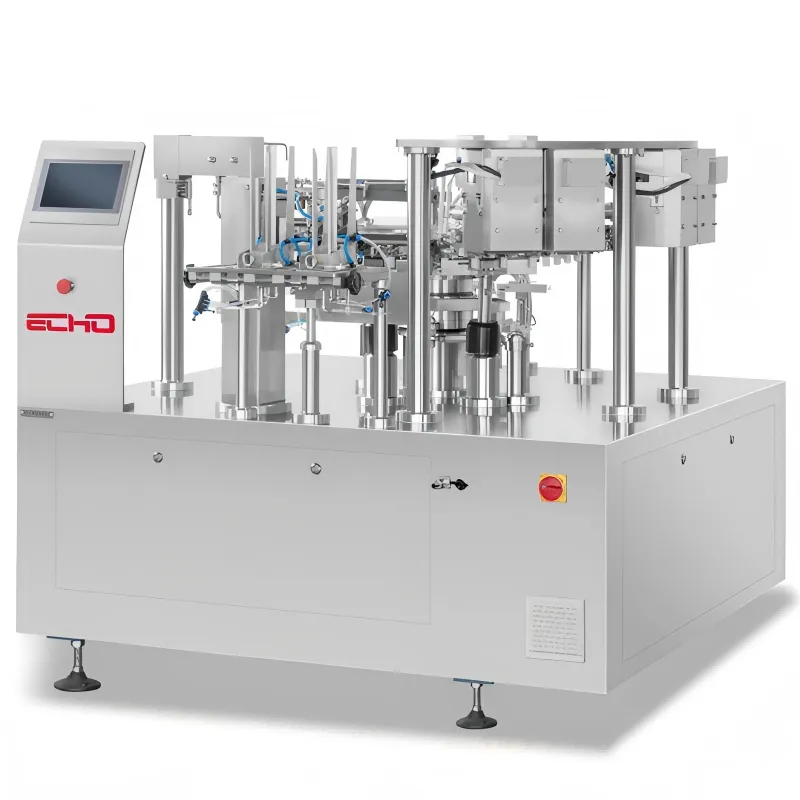
The Cold Truth: Why Heat Is the Enemy of Protein Bar Packaging
A protein bar fresh from the cooling tunnel carries a chocolate coating tempered to a glossy finish, a core texture engineered for the right chew, and a surface free of the whitish bloom that signals fat migration. Run that same bar through a heat-seal flow wrapper with sealing jaws set to 130°C, and the surface that contacts the end-seal zone reaches temperatures well above chocolate's melting point — 34°C for milk chocolate, 38°C for dark. The coating melts where the seal hits the bar surface, resolidifying with dull patches and distorted edges. The heat pulse travels into the bar core, softening the protein matrix and creating a textural inconsistency between the sealed ends and the bar center. After cooling, fat migration from the coating into the bar surface — accelerated by the heat exposure — appears as a whitish film within 48 hours.
A protein bar packaging machine equipped for cold-seal operation eliminates this heat damage entirely by replacing thermal bonding with pressure-activated adhesive. Cold-seal film carries a pre-applied cohesive coating on its inner sealant layer — a natural or synthetic latex adhesive that bonds only to itself under pressure, not to the product surface. The flow wrapper's sealing jaws apply mechanical pressure at ambient temperature, the adhesive layers on opposing film surfaces press together and bond, and the seal forms without any thermal energy input. The bar never exceeds room temperature, the coating stays intact, and the texture remains uniform from end to end.
How Cold-Seal Adhesives Work at the Chemistry Level
Cohesive Bonding Without Heat
Cold-seal adhesives are cohesive — meaning they bond to themselves, not to the product or the outer film surface. This is the feature that prevents the package from sticking to the protein bar during sealing: the adhesive coating faces inward on both the top and bottom film layers, and when the jaws press them together, adhesive-to-adhesive contact forms the seal. The product sits between these layers without contacting the adhesive.
The adhesive formulation typically combines natural rubber latex for immediate tack with synthetic polymers for controlled bond strength, creating a seal that holds at the film's burst pressure — typically 30–50 kPa for a snack-sized package — but opens with a peel force low enough that consumers do not need scissors. The tradeoff: cold-seal bonds achieve approximately 70% of the strength of heat-seal bonds of equivalent area, so cold-seal packages need wider seal zones — typically 8–10 mm versus 5–6 mm for heat-seal — which increases film consumption per package by 5–8%. ECHO Machinery's form-fill-seal packaging equipment is compatible with cold-seal film operation, supporting pressure-jaw configurations optimized for cold-seal dwell time and pressure requirements.
Real-World Application: Heat-Seal to Cold-Seal Conversion
A nutrition-bar manufacturer producing chocolate-coated whey protein bars on a heat-seal flow wrapper was experiencing a 4% defect rate — bars with melted coating at the seal ends, visible as dull patches that quality control flagged for rework. The defect cost, at 40 bars per thousand scrapped and reworked, represented approximately $18,000 in annual product loss for a single line running one shift.
Converting to a cold-seal system on an ECHO Machinery packaging platform — which involved replacing the heated sealing jaws with pressure-only jaws, switching to cold-seal film with a registered adhesive pattern, and adjusting seal dwell time to 0.4 seconds — eliminated the defect entirely. The cold-seal adhesive bonds at ambient temperature, so the chocolate coating never exceeds 28°C even at the seal contact point. The tradeoff in speed — the line now runs at 65 packs per minute versus the previous 90 packs per minute on heat-seal — was more than offset by the elimination of the 4% defect rate and the elimination of post-package cooling time (heat-sealed bars needed 90 seconds of cooling-conveyor time; cold-sealed bars skip the cooling section entirely). Net throughput per shift actually increased by 8% because the line no longer stops for rework and no longer requires cooling-conveyor dwell before case packing.
Frequently Asked Questions
Why do protein bars need cold-seal packaging specifically?
Protein bars combine heat-sensitive coatings (chocolate, yogurt, compound) with textured cores that soften at temperatures above 40°C. Heat-seal temperatures of 120–160°C irreversibly damage these surfaces even with brief contact. Cold-seal packaging, using pressure-activated adhesive bonds at ambient temperature, preserves coating integrity and core texture. ECHO Machinery's packaging machines support both heat-seal and cold-seal configurations.
How fast can a cold-seal protein bar machine run?
Cold-seal lines typically run at 40–80 packs per minute — slower than heat-seal because the adhesive requires 0.3–0.6 seconds of dwell time under pressure to form a reliable bond, versus 0.05–0.15 seconds for heat-seal film. The exact speed depends on seal width, adhesive formulation, and jaw pressure — wider seals with higher bond-strength adhesives allow faster cycle times.
Does cold-seal film cost more than heat-seal film?
Yes — cold-seal film carries a 10–15% price premium per square meter due to the additional manufacturing step of applying the adhesive pattern, typically in a registered pattern that leaves adhesive-free lanes for the fin seal. This cost is offset by reduced product waste from heat-damaged bars, which can represent 2–5% of output on a heat-seal line.
What is the shelf life of cold-seal film?
Cold-seal adhesive has a limited open time — the period after the film is unwound during which the adhesive retains its bonding capability — typically 6–12 months from the manufacturing date. Film stored at temperatures above 30°C or in high humidity loses bond strength faster. Always check manufacturer date codes and store cold-seal film in climate-controlled conditions (20–25°C, 40–60% RH).
How do you test cold-seal integrity on a protein bar package?
Perform a burst test (inflate the sealed package with compressed air until the seal fails — the burst point should be at least 20 kPa for snack-bar packaging). Perform a peel test on the cross-seal area (measure the force required to separate the seal at 90-degree angle — should exceed 2 N per 15 mm of seal width for a reliable cold-seal bond).
Can cold-seal machines switch to heat-seal operation?
Machines designed for cold-seal-only operation lack heated jaw assemblies and temperature controllers. Dual-mode machines — like certain ECHO Machinery configurations — include both heated jaw capability and cold-seal pressure control, allowing switching between modes. Always verify cooling-zone length on dual-mode machines: heat-seal packages need 20–30 cm of cooling conveyor before reaching the collection area to allow seals to set.