
 EN
EN
Rethinking the Pouch: How Material Innovation Is Changing Snack Packaging Bags
A standard potato chip bag looks like a single material — shiny foil on the outside, plastic film on the inside. In reality, it is a lamination of three to five different polymers, each chosen for a specific function: a printable outer layer (OPP or PET), an oxygen barrier (aluminum foil or metallized film), a structural layer (OPA or PET for puncture resistance), and a heat-sealable inner layer (PE or CPP). This multi-material construction gives snack packaging bags extraordinary shelf-life performance — protecting product freshness for up to 12 months — but makes them impossible to recycle through conventional mechanical recycling because the layers cannot be separated economically.
The shift toward mono-material packaging — structures where all layers are the same polymer family, typically all-polyethylene (PE) or all-polypropylene (PP) — is the dominant sustainability trend in snack packaging bags today. In a mono-PE structure, a high-density PE (HDPE) outer layer provides stiffness and printability, a middle PE layer with barrier coating (SiOx or AlOx) provides oxygen and moisture protection, and a low-density PE (LLDPE) inner layer provides heat-seal performance — all layers chemically compatible for recycling as a single stream. ECHO Machinery's form-fill-seal equipment is compatible with these evolving film structures, supporting packaging operations adapting to mono-material films.
The Barrier Challenge: Why Mono-Materials Are Harder to Make
Compromising Without Composite
Multi-material laminates excel because each layer is optimized for one function: aluminum foil provides near-zero oxygen transmission, PET provides stiffness, PE provides sealability. A mono-material structure forces all these functions into layers of the same polymer, created through different polymerization processes and additive packages. The result is a film with barrier properties approximately 70–80% as effective as a traditional multi-material laminate of the same thickness — enough for snack products with shelf lives under 6 months, insufficient for products requiring 12-month ambient stability.
Two technologies are narrowing this performance gap. Oriented PE (OPE) — created by stretching PE film in one or two directions during manufacturing — improves stiffness and clarity to near-PET levels. And barrier coatings: silicon oxide (SiOx) or aluminum oxide (AlOx) deposited in a plasma chamber create a transparent barrier layer thinner than a human hair that provides oxygen transmission rates under 1 cc/m²/day, competitive with aluminum foil but without the recycling incompatibility. ECHO's DXD 1200 series horizontal packaging machines can run these advanced film structures — servo-driven tension control that maintains consistent film feed even as film stiffness decreases during machine warm-up, a common issue with PE-based films that have a lower softening point than PET or OPA.
Real-World Application: A Snack Brand's Mono-Material Transition
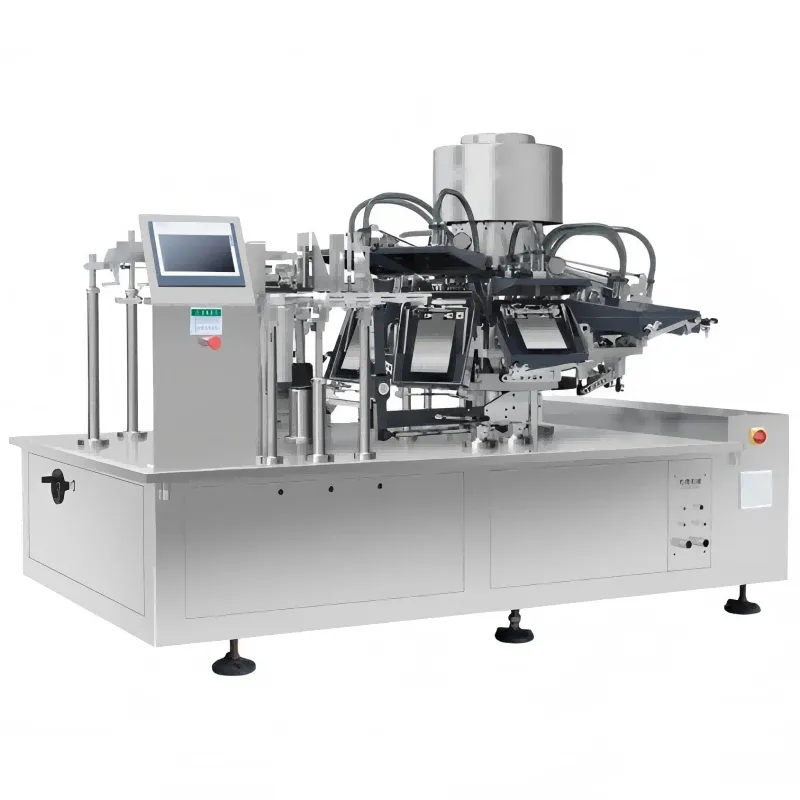
A European trail-mix brand committed to 100% recyclable packaging by 2027 began testing mono-PE pouches on an existing ECHO Machinery horizontal packaging line that had been running PET/met-PET/PE laminates for five years. The first production trial produced 30% waste: the PE-only film stretched under the forming-shoulder tension that the stiffer PET laminate had handled without issue, creating bag-length variations of ±4 mm — unacceptable for the brand's retail-shelf presentation standards. The solution was not a machine replacement but a parameter adjustment: reducing film unwind tension by 30%, lowering the forming-shoulder entry angle by 3 degrees to reduce drag, and adding a tension-dancer roller to absorb the small continuous stretch characteristic of PE films. After these adjustments — completed within a single maintenance shift — bag-length variation dropped to ±0.8 mm, within specification. The brand now runs both PET-laminate and mono-PE film on the same machine with recipe-based parameter switching stored in the HMI, recovering the changeover time within the first 20 bags.
Frequently Asked Questions
What makes snack packaging bags difficult to recycle?
Most snack bags are multi-material laminates — a layer of aluminum foil bonded between layers of different plastics using adhesives. Mechanical recycling facilities cannot separate these layers, and the mixed material contaminates recycling streams. Mono-material designs solve this by making all layers from the same polymer family. Companies like ECHO Machinery support the transition by ensuring equipment compatibility with these newer materials.
Are bio-based snack packaging films commercially available?
Yes. PLA (polylactic acid) films derived from corn starch are used for fresh-produce and short-shelf-life snack applications, though their moisture-barrier performance is lower than petroleum-based films. PHA (polyhydroxyalkanoate) films offer better barrier properties but at higher cost. Both are industrially compostable under controlled conditions, not biodegradable in home compost or landfill.
How do snack packaging machines handle recycled-content films?
Post-consumer recycled (PCR) PE films contain gel particles and contamination that create weak spots during heat sealing. Machines processing PCR films may need 5–10°C higher sealing temperatures and slower seal dwell times to achieve equivalent seal strength. ECHO Machinery's temperature control and jaw-pressure adjustments accommodate these requirements.
What is the difference between recyclable and compostable snack packaging?
Recyclable packaging enters the mechanical recycling stream, where it is ground, washed, and re-pelletized into new plastic. Compostable packaging is designed to break down into organic matter in industrial composting facilities operating at 58–65°C — conditions not available in home compost or most landfill environments.
Will mono-material snack packaging cost more than traditional laminates?
Currently yes — mono-material films with barrier coatings are 15–30% more expensive per square meter than equivalent-performance multi-material laminates. Price premiums are expected to decrease as production volumes increase and coating technology becomes more efficient. Some brands offset cost through reduced disposal fees and compliance with extended producer responsibility (EPR) regulations.
How do you verify that a snack packaging film is compatible with your machine?
Run a trial of at least 5,000 bags under production conditions. Monitor for film stretching (check bag-length consistency), seal-quality drift (measure seal strength every 30 minutes), and static buildup (monitor film tracking on the forming shoulder). ECHO Machinery provides trial-run support for new film qualifications.