
 EN
EN
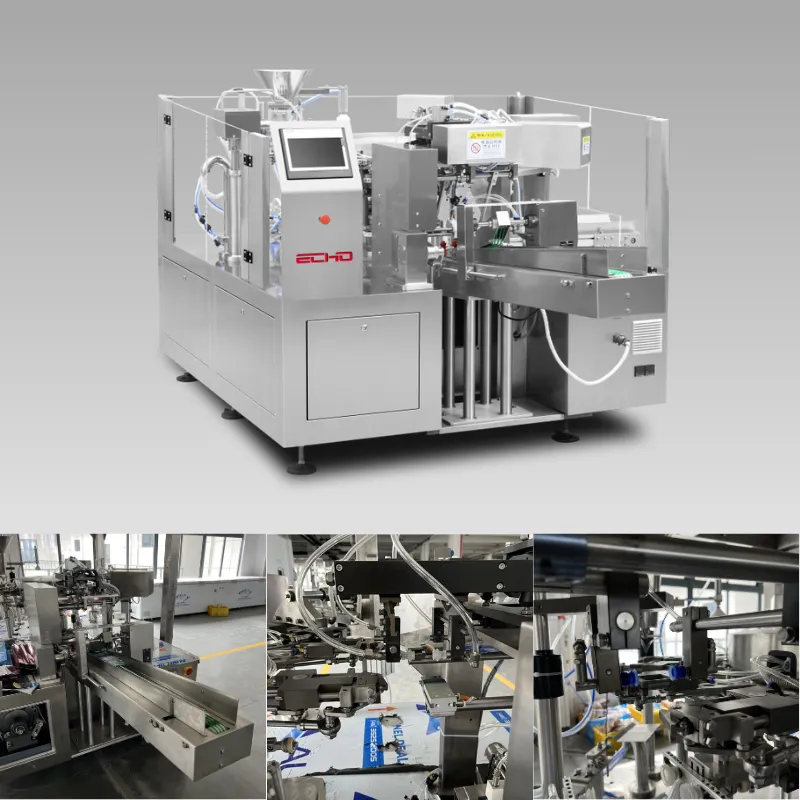
By Bag Formation Method: Premade Pouch vs. Form-Fill-Seal Systems
Premade Pouch Packing Machines: Precision Handling for Pre-Cut Bags
Premade pouch machines handle pre-manufactured bags delivered in their final form. Using vacuum mechanisms or air jets, these systems select and open pouches from a magazine before precise product filling. Key strengths include support for sophisticated pouch designs with retail-ready finishes, compatibility with specialized features like spouts, zippers, and custom shapes, and faster setup cycles compared to roll-fed alternatives. Their precision handling suits high-value products where premium packaging aesthetics and structural integrity are critical—though material costs are typically higher than form-fill-seal options.
Form-Fill-Seal (FFS) Pouch Packing Machines: Continuous Roll-Fed Efficiency
Form-fill-seal pouch packing machines create pouches directly from film rolls during packaging—forming, filling, and sealing in one continuous operation. This integrated approach delivers 30%+ material savings by eliminating pre-cut pouch waste, reduces changeover times for rapid product switching, and lowers per-unit costs for high-volume production runs. FFS systems prioritize efficiency and scalability, making them ideal for manufacturers prioritizing throughput and material economy over complex pouch configurations.
By Motion Architecture: Vertical vs. Horizontal Pouch Packing Machines
Motion orientation fundamentally impacts pouch packing efficiency and space utilization. The two primary architectures—vertical and horizontal—each excel in distinct operational contexts.
Vertical Form-Fill-Seal (VFFS) Pouch Packing Machines
VFFS machines pull film vertically from a roll, forming pouches through a sequential tube-shaping, filling, and sealing process. Their compact footprint minimizes floor space—ideal for facilities with spatial constraints. Industry studies show VFFS systems dominate packaging for free-flowing products like coffee granules (85% adoption in food processing), leveraging gravity-assisted filling for reliability. High-speed servo controls handle weights from 5g–5kg with ±0.5% precision, while integrated load cells ensure portion accuracy for pharmaceuticals. Touchscreen interfaces simplify pouch dimension adjustments—critical for brands launching limited-edition packaging.
Horizontal Form-Fill-Seal (HFFS) Pouch Packing Machines
HFFS machines create pouches along a horizontal plane, making them ideal for bulky or irregularly shaped items like protein bars or medical devices. Products travel on conveyors into pre-formed film wraps—reducing product damage for fragile goods by 40% compared to vertical systems. Horizontal machines typically achieve 20% higher speeds than vertical counterparts when packaging rigid items (120+ pouches/minute). Their elongated footprint suits high-volume factories with ample floor space, while multi-lane configurations enable simultaneous packaging of varied SKUs. Advanced models integrate X-ray inspection for compliance-sensitive sectors like nutraceuticals.
By Automation Level: Matching Throughput and Labor Requirements
Selecting the appropriate automation level significantly impacts production volumes and workforce efficiency. Manual systems handle 5–15 pouches/minute and require constant operator attention for bag placement and quality checks—ideal for niche products or small batch runs. Semi-automated models boost output to 20–40 pouches/minute by automating core functions like filling and sealing while retaining manual loading, balancing throughput gains with moderate labor costs. Fully automated systems—with robotics-integrated feeding and packing lanes—support high-volume operations exceeding 80 pouches/minute, minimizing human intervention while optimizing throughput. Industry data indicates upgrading to semi-automation reduces labor costs by 30–50%, whereas full automation cuts labor dependency by 70–90% despite higher upfront investment. Align your choice with daily production targets and workforce availability to maximize ROI.
By Product Compatibility: Tailoring Filling Systems for Powders, Liquids, and Granules
Pouch packing machines require specialized filling systems to handle different product consistencies effectively. Powders demand precision technology like auger fillers or net-weight fillers to prevent clumping and ensure accurate measurements—adjusting dynamically to granular size and moisture sensitivity. Liquids need viscosity-adapted solutions such as flow meters or piston fillers that maintain consistent volumes without splashing or foaming; thicker substances require slower dispensing rates and specialized nozzles. Granules work best with volumetric cup fillers that handle free-flowing materials at high speeds. In food-grade applications, stainless steel components are essential for hygiene compliance. Matching the filling mechanism to product characteristics reduces waste by 12–18%, ensuring each machine maintains throughput while accommodating diverse product lines.
FAQ
What are the key differences between premade pouch machines and form-fill-seal (FFS) systems?
Premade pouch machines handle pre-manufactured pouches and are ideal for high-value products requiring premium finishes. In contrast, FFS systems create pouches from film rolls during the packaging process, emphasizing material efficiency and scalability.
When should I choose vertical over horizontal pouch packing machines?
Vertical machines are compact and excellent for free-flowing or small-sized products. On the other hand, horizontal machines are suitable for bulky or fragile items and offer higher speeds for rigid products.
How does automation level impact operational efficiency?
Manual systems are suited for low-volume production, semi-automated systems increase efficiency at moderate labor costs, and fully automated systems enhance throughput and significantly reduce labor dependency while requiring higher investment.
What filling mechanisms work best for powders, liquids, and granules?
Powders require auger or net-weight fillers, liquids need flow meters or piston fillers, and granules are best handled by volumetric cup fillers. Tailoring the filling system to the product ensures accuracy and minimizes waste.