
 EN
EN
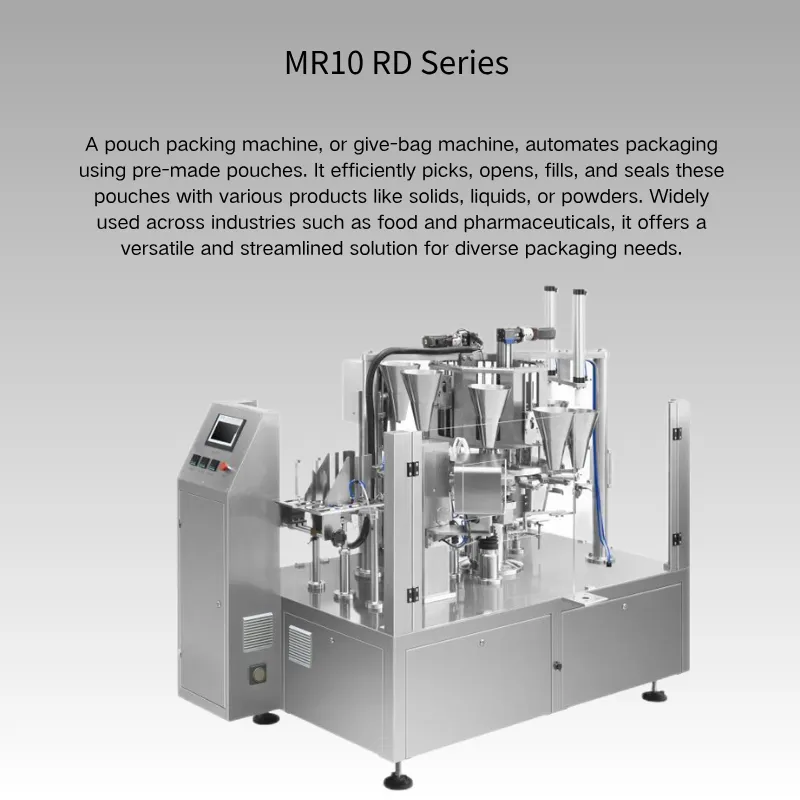
Understand Pouch Packing Machine Types and Their Product Fit
VFFS, HFFS, and Premade Pouch Machines: Core Mechanics and Best-Use Scenarios
Vertical Form-Fill-Seal (VFFS) machines form pouches from rollstock film in a vertical configuration—leveraging gravity for fast, efficient filling of dry, free-flowing products like coffee granules or snack foods. Horizontal Form-Fill-Seal (HFFS) systems build pouches laterally, offering superior control for delicate or viscous contents such as yogurt, sauces, or liquid detergents, minimizing splashing and improving seal integrity. Premade pouch machines bypass forming entirely, loading pre-fabricated pouches—ideal for complex formats like spouted beverage packs, stand-up pouches with zippers, or recyclable mono-material designs.
- VFFS: Highest throughput (up to 160 pouches/minute), best suited for uniform dry goods where speed and cost-efficiency are paramount
- HFFS: Optimized for gentle, precise volumetric or weight-based filling of liquids and semi-solids; supports stringent hygiene requirements
- Premade: Enables full design flexibility and premium aesthetics but trades off speed for format fidelity and sustainability alignment
Choose VFFS for high-volume snack or cereal packaging, HFFS when handling temperature-sensitive or contamination-prone liquids, and premade systems when brand differentiation, recyclability, or regulatory compliance (e.g., EU PPWR) demands specific pouch architecture.
Filling Technology Alignment: Liquids, Powders, Granules, and Count-Based Items
Filling accuracy hinges on matching product physics to the right mechanism. Auger fillers prevent compaction and ensure consistent dosing of fine powders like flour or protein blends. Servo-controlled piston fillers deliver repeatable volume accuracy for oils and pastes, while weigh-fillers achieve ±0.5% precision for granular items such as rice or pet food. For count-based products—including pharmaceutical tablets or premium confectionery—optical or mechanical counters guarantee unit-level consistency without contact-induced damage.
| Product Type | Filling Technology | Key Advantage |
|---|---|---|
| Free-flowing powders | Auger screw | Reduces clumping; 12% more accurate than gravity fillers |
| High-viscosity pastes | Servo-driven piston | Maintains dose stability; 8% more precise than rotary pumps |
| Fragile solids | Vibration-assisted cup | Minimizes breakage; 15% fewer rejects vs. conveyor-based methods |
Misaligned filling technology contributes directly to waste—PMMI (2023) reports up to 5.7% product loss from improperly configured liquid fillers. Always validate compatibility against your product’s temperature sensitivity, particle size distribution, and flow characteristics before finalizing machine selection.
Prioritize Critical Performance and Compliance Specifications
Selecting a pouch packing machine requires rigorous evaluation of performance thresholds and regulatory adherence to avoid costly production disruptions.
Throughput Realities: Matching Output Speed, Pouch Size Range, and Automation to Your Production Volume
Rated speeds are theoretical—and often unattainable under real-world conditions. A machine advertised at 60 pouches/minute may sustain only 40/min when running gusseted, laminated, or metallized pouches with viscous fill. Always validate throughput using your exact pouch format, film structure, and product viscosity. Automation scalability matters: semi-automatic models support low-volume runs (<5,000 pouches/day), while fully integrated lines—with robotic pick-and-place, vision inspection, and palletizing—are essential above 25,000 pouches/day to maintain line balance and labor efficiency.
Sanitary Design, CE/FDA Compliance, and Pouch Format Support (Stand-Up, Zipper, Gusseted)
In food and pharmaceutical applications, sanitary design isn’t optional—it’s foundational. Look for machines built with FDA-grade stainless steel (304 or 316), fully drainable surfaces, and validated Clean-in-Place (CIP) or Steam-in-Place (SIP) capability. CE marking under the Machinery Directive (2006/42/EC) and compliance with FDA 21 CFR Part 117 (for food) or Part 211 (for pharma) must be documented—not just claimed. Industry data (2024) shows non-compliant equipment contributes to over 30% of avoidable recalls, with average penalties exceeding $100,000 per incident.
Verify pouch versatility upfront: Does the sealer accommodate aluminum foil or barrier laminates? Can the film feed system auto-adjust for side-gusset depth or zipper tape placement? Leading manufacturers offer modular sealing heads, interchangeable former tubes, and quick-change tooling—enabling future format expansion without full machine replacement.
Calculate True Value: Total Cost of Ownership and Vendor Partnership Quality
ROI Beyond Price: Downtime Reduction, Labor Savings, and Long-Term Operational Efficiency
Total cost of ownership (TCO) is the definitive metric—not sticker price. Unplanned downtime costs U.S. manufacturers an average of $740,000 annually (Ponemon Institute, 2023), with pouch line stoppages averaging $22,000/hour in lost output. Automation-compatible machines reduce manual intervention by 30%, cutting labor-related errors and staffing costs—$45,000/year per shift, according to industry benchmarks. Energy-efficient servo drives and IE4 motors lower electricity consumption by 15–20% over five years, contributing to an 18% reduction in ongoing operational expenses.
| Cost Factor | Impact on TCO |
|---|---|
| Downtime Reduction | Prevents $22k/hour production losses |
| Labor Automation | Saves $45k/year in staffing per shift |
| Energy Efficiency | Lowers operational expenses by 18% |
Prioritize reliability-engineered platforms—those with predictive maintenance alerts, standardized components, and field-proven uptime records. These extend service life beyond 12 years and compound ROI through sustained throughput and minimal lifecycle surprises.
Evaluating Supplier Trustworthiness: Onsite Demos, Responsive Support, and Proven Food Industry Experience
Trust is earned—not assumed. Require an onsite demonstration using your product, film, and target pouch format. This reveals real-world performance gaps no spec sheet can expose. Evaluate support responsiveness rigorously: vendors offering 24/7 technical assistance cut mean time to repair (MTTR) by 70%, according to third-party service audits. Confirm sector-specific credibility through three non-negotiable indicators:
- Validated CIP/SIP protocols aligned with your facility’s sanitation schedule
- Region-specific compliance documentation (e.g., FDA registration, CE DoC, UKCA)
- Published case studies with comparable products—same viscosity range, particulate profile, or regulatory classification
A supplier with deep food industry experience anticipates evolving standards—from EU Packaging and Packaging Waste Regulation (PPWR) to FSMA 204 traceability mandates—and embeds those requirements into machine design, training, and service planning. That partnership doesn’t just install equipment—it secures long-term operational resilience.
FAQ
- What is the difference between VFFS, HFFS, and premade pouch machines? VFFS machines form pouches vertically, ideal for dry goods, while HFFS forms them horizontally for liquid or delicate products. Premade machines use pre-formed pouches for premium and sustainable packaging.
- What filling technology is suitable for fragile solids? Vibration-assisted cups are ideal as they minimize breakage and reduce rejects by up to 15% compared to conventional methods.
- How does Total Cost of Ownership (TCO) affect machine selection? TCO considers long-term costs like downtime, energy efficiency, and maintenance, making it key to ensuring a higher ROI and sustained operational efficiency.
- How can I ensure my pouch packing machine complies with regulatory standards? Look for machines with CE marking, CIP/SIP validation, and compliance to FDA or other region-specific requirements to avoid production disruptions or recalls.
- Why are onsite demos important? They expose real-world performance gaps, allowing you to understand how the machine processes your specific product and pouch format under operational conditions.