
 EN
EN
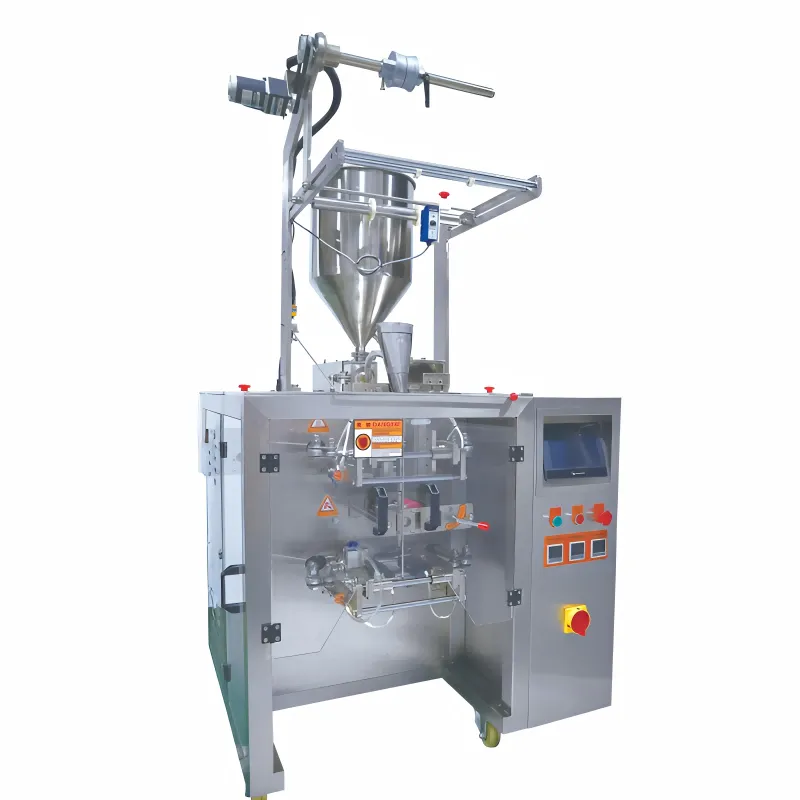
How Vertical Form Fill and Seal Machines Work and Where They Excel
The Four-Stage Process: Forming, Filling, Sealing, and Cutting
Vertical form fill and seal (VFFS) machines automate packaging through four synchronized stages:
- Forming: A flat film roll unwinds and wraps around a vertical forming tube to create a continuous pouch-shaped sleeve
- Filling: Product is dispensed through the tube into the formed pouch at controlled volumes
- Sealing: Horizontal sealing jaws simultaneously seal the top of the current pouch and the bottom of the next—enabling continuous motion
- Cutting: A rotary or reciprocating knife separates individual packages from the film web
This uninterrupted cycle supports speeds exceeding 200 bags/minute while minimizing product contact—reducing contamination risk and labor dependency.
Key Applications Across Food, Pharma, and Chemical Packaging
VFFS systems are widely adopted in regulated and high-value sectors due to their precision, cleanliness, and adaptability:
- Food: Ideal for granules (e.g., coffee), powders (e.g., spices), and liquids (e.g., sauces), especially where hermetic seals preserve freshness and shelf life
- Pharmaceuticals: Supports sterile, ISO Class 5-compliant packaging of tablets, capsules, and single-use medical devices
- Chemicals: Safely packages aggressive formulations like detergents and solvents when paired with chemically resistant films
Their compact vertical layout and rapid format changeovers make them especially valuable for small-batch production and facilities with limited floor space. Film selection—including multi-layer laminates with PE, PP, EVOH, or metallized layers—further tailors barrier performance against moisture, oxygen, UV light, or vapor transmission.
Product and Packaging Material Compatibility with Vertical Form Fill and Seal
Matching Product Types — Powders, Liquids, Granules, and Fragile Items
VFFS technology adapts to diverse physical product properties through configurable filling systems:
- Powders (e.g., protein supplements) flow reliably via auger fillers calibrated for ±1% dosing accuracy—critical for low-bulk-density materials
- Granules (e.g., coffee beans, pet food) use vibration-assisted feeders to maintain consistent flow and prevent bridging
- Liquids (e.g., oils, dressings, sauces) rely on servo-controlled nozzles that eliminate drip and synchronize with high-speed sealing to prevent leakage
- Fragile items (e.g., chips, crackers) benefit from drop-height regulators and air-cushioned forming tubes—reducing breakage to under 2%
Machine responsiveness is enhanced by integrated sensors: viscosity detectors adjust liquid fill speed in real time, while vacuum assist stabilizes dusty or aerated powders.
Film Selection and Sealing Technology’s Impact on Barrier Performance
Packaging film composition and sealing parameters directly determine functional performance:
- Multilayer laminates (e.g., PE/PP/EVOH) achieve moisture-vapor transmission rates below 0.5 g/m²/day—essential for hygroscopic pharmaceuticals and roasted coffee
- Heat-sealing integrity depends on precise temperature (300–400°F), dwell time, and jaw pressure; insufficient pressure contributes to seal failures in up to 17% of cases
- Metallized films block 99% of UV light for photosensitive chemicals, while micro-perforated variants allow controlled gas exchange for fresh produce
- Advanced jaw designs accommodate film thicknesses from 60–200 microns without compromising seal strength or material economy
These capabilities ensure compatibility across demanding applications—from sterile medical device pouches to high-barrier food packaging.
Operational Fit: Space, Speed, Flexibility, and Integration
Footprint, Height Requirements, and Line Integration Challenges
VFFS machines optimize facility utilization by stacking operations vertically—reducing required floor space by up to 40% compared to horizontal alternatives. However, their height (often 10–15 feet) may require ceiling clearance adjustments in older or retrofit facilities. Seamless integration demands tight synchronization with upstream feeders (e.g., bulk hoppers, vibratory bowls) and downstream conveyors or case packers. Legacy lines frequently need custom interfaces or PLC-level communication upgrades to avoid bottlenecks. Additionally, heat-sealing zones generate ambient heat, necessitating localized ventilation—particularly important for temperature-sensitive products like chocolate or probiotics.
Changeover Time, Format Flexibility, and Throughput Scalability
Modern VFFS platforms prioritize agility: quick-release tooling and digital recipe storage enable full format changeovers—between pouch sizes, styles, or film types—in under 15 minutes. Broad film compatibility allows one machine to handle flat-bottom, stand-up, gusseted, or spouted pouches without mechanical retooling. For throughput growth, modular architecture supports incremental capacity expansion—adding a second VFFS unit alongside existing equipment can increase output by up to 200% without requiring new floor space. This scalability makes VFFS especially effective for managing seasonal demand surges or launching new SKUs rapidly.
Vertical Form Fill and Seal ROI: Cost, Labor, and Strategic Alignment
Vertical form fill and seal machines deliver strong, measurable ROI across three strategic dimensions: operational efficiency, labor optimization, and long-term adaptability. Automation reduces direct labor needs by up to 75% versus manual packaging—enabling a single operator to manage outputs equivalent to six manual workers at speeds of 60–100 units/minute. Precision dosing and tension-controlled film handling also cut product giveaway and film waste, lowering consumables costs.
Strategically, payback periods average 12–18 months in high-volume operations. The compact footprint preserves capital-intensive floor space, while modular upgrades support future capacity increases without facility expansion. Quick-change tooling and digital recipe management let manufacturers pivot between packaging formats—responding to shifting consumer preferences or regulatory requirements—without costly reengineering. Together, these advantages position VFFS not just as packaging equipment, but as a foundational enabler of agile, scalable, and cost-competitive manufacturing.
Frequently Asked Questions
- What are the main advantages of using VFFS machines? VFFS machines offer automation, increased speed, reduced labor costs, and precise packaging capabilities, benefiting high-value sectors like food, pharmaceuticals, and chemicals.
- Can VFFS machines handle different types of products and packaging films? Yes, they accommodate various product types including powders, liquids, granules, and fragile items, and work with multiple packaging films to meet specific barrier and sealing requirements.
- How does vertical form fill and seal technology improve operational efficiency? By reducing required floor space, offering quick format changeovers, and enabling modular scalability, they significantly enhance operational efficiency in manufacturing facilities.