
 EN
EN
Portion by Portion: The Design Trends Driving Instant Coffee Packaging Forward
Single-serve instant coffee has moved well beyond the foil sachet. What was once a purely functional format — tear open, pour, discard — now carries brand identity, sustainability messaging, and sensory experience cues within roughly 15 square centimeters of packaging real estate. The transformation reflects shifts in consumer expectations, material science advances, and manufacturing capabilities that allow smaller formats to carry bigger brand stories.
Material Innovation Driving Format Evolution
Why Barrier Requirements Dictate Single-Serve Structure Choices
Instant coffee is hygroscopic — it absorbs moisture from ambient air, leading to clumping, flavor degradation, and shortened shelf life. Single-serve instant coffee packaging must therefore deliver moisture barrier performance comparable to multi-serve formats despite thinner material gauges.
Traditional stick packs use a three-layer laminate: PET (print layer) / aluminum foil (barrier) / PE (sealant). This structure achieves water vapor transmission rates (WVTR) below 0.1 g/m²/day — essential for products targeting 18–24 month shelf lives in tropical distribution environments. The trade-off: aluminum foil laminates are neither recyclable nor biodegradable through conventional municipal waste streams.
Newer material combinations substitute aluminum foil with metallized PET or silicon oxide (SiOx) coated films. These transparent or semi-transparent barriers achieve WVTR of 0.3–0.8 g/m²/day — adequate for 12-month ambient shelf life while enabling mono-material structures that improve recyclability. For brands marketing sustainability credentials, the visual cue of a non-foil pack signals environmental intent before consumers read a single word on the label.
Stick Pack vs. Flow-Wrap Sachet: Throughput and Consumer Experience
Stick packs dominate the instant coffee packaging landscape for good reason: they run at 400–600 packs per minute on vertical form-fill-seal equipment, use roughly 30% less material than equivalent-volume flat sachets, and fit naturally into cup-rim dispensing displays at convenience stores and hotel breakfast bars.
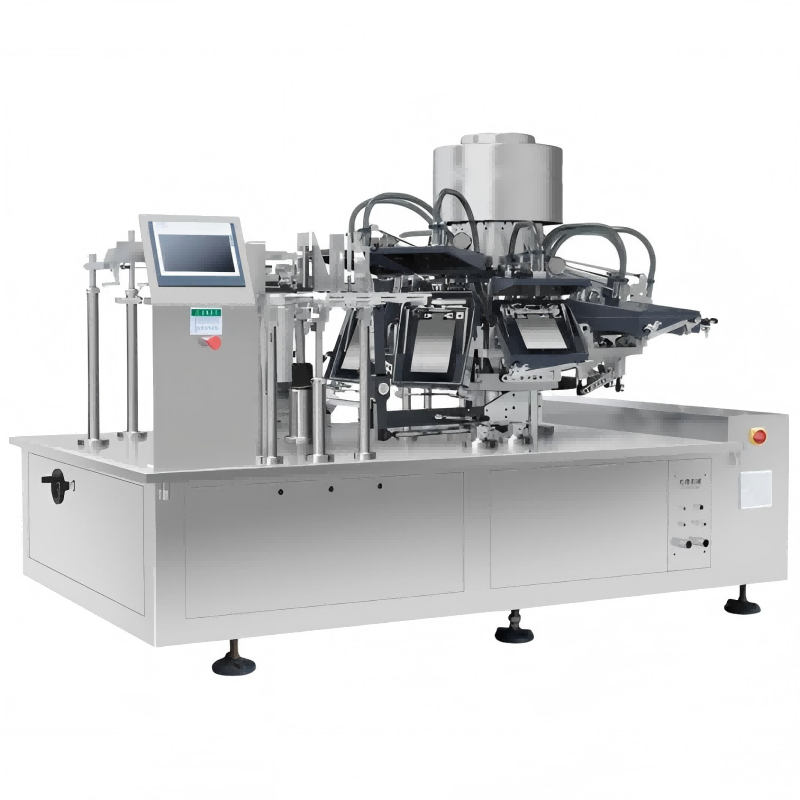
Flow-wrap sachets, by contrast, offer a larger printable surface area — useful for brands needing to display multilingual regulatory text, QR codes linking to origin stories, or photographic product imagery. The format choice ultimately balances production speed against branding surface. ECHO Machinery's dual pouch feeder systems accommodate both formats on a single platform, reducing changeover downtime when brands diversify across stick packs and flat sachets within the same production run.
The Visual Language of Premium Single-Serve
How Matte Finishes and Spot Gloss Communicate Quality
A matte-finish instant coffee packaging surface signals "specialty" rather than "commodity" — the tactile experience of a soft-touch overprint varnish creates a premium impression that glossy laminates cannot replicate. Spot gloss accents on logo elements or key product claims create contrast that draws the eye to specific information hierarchy points. The combination costs roughly 8–12% more than standard gloss lamination but consistently outperforms in shelf-impact studies.
Brands entering specialty retail channels — independent coffee shops, boutique grocers, hotel minibars — benefit disproportionately from elevated single-serve packaging because the format itself communicates portion control and freshness, while premium finishes communicate quality that justifies higher per-unit pricing.
Real-World Brand Application
A Southeast Asian instant coffee brand exporting to European specialty retailers faced rejection from a key buyer who considered their existing metallized sachets indistinguishable from bulk-commodity instant coffee. The brand redesigned their single-serve instant coffee packaging with a matte-finish stick pack featuring a transparent window — revealing the freeze-dried crystals inside — and switched from solvent-based to water-based inks for EU compliance. Within six months of the redesign, specialty retail distribution expanded from 40 to 220 doors across Germany and the Netherlands. Production used ECHO Machinery's automated stick-pack systems, maintaining 500 packs-per-minute output with the new material structure.
Frequently Asked Questions
What is the shelf life of single-serve instant coffee in stick packs?
Standard aluminum-foil laminate stick packs provide 18–24 months of ambient shelf life. Metallized PET structures typically deliver 12–18 months. Actual shelf life depends on storage conditions — temperatures above 30°C accelerate moisture ingress and flavor degradation regardless of barrier quality.
Are stick packs recyclable?
Conventional multi-layer stick packs with aluminum foil are not recyclable through curbside programs. Emerging mono-material PE or PP structures improve recyclability where appropriate collection streams exist. Brands should verify local recycling infrastructure before making recyclability claims on-pack.
What fill weights do stick packs accommodate?
Single-serve instant coffee packaging typically handles 1.5–5 grams per stick pack — suitable for 120–200ml cup preparation. Larger format stick packs for 250–350ml servings run 6–10 grams. ECHO Machinery's filling systems achieve ±0.1g accuracy at these low fill weights.
How does nitrogen flushing extend instant coffee shelf life?
Residual oxygen inside sealed packaging accelerates oxidation of coffee oils and aroma compounds. Nitrogen flushing reduces headspace oxygen below 1%, extending flavor stability by 30–50% compared to non-flushed packs. Integrated gas flushing on modern packaging lines adds approximately 0.3 seconds per cycle — negligible throughput impact.
What printing methods work for small-format instant coffee packaging?
Gravure printing dominates for runs above 50,000 units due to lower per-unit cost and consistent color reproduction. Digital printing suits shorter runs (5,000–30,000 units) and enables variable-data printing for limited editions or regional market variants. Flexographic printing bridges the gap for mid-volume production.
Can plant-based instant coffee packaging materials match conventional barrier performance?
Current plant-based barrier coatings (PVDC-free, bio-based coatings) achieve WVTR of 1.0–3.0 g/m²/day — adequate for 6–9 month shelf life. They do not yet match aluminum foil at sub-0.1 g/m²/day. Brands using plant-based structures should plan for shorter distribution cycles or climate-controlled warehousing.